Saturday, November 22, 2008

5 tips for startups for handling the power situation

Recently we have had a few power outages in our office at Pune. After about 3 days of facing the crisis, I had to find a solution for this problem. Following are 5 tips for startups for handling the power situation. These tips are specifically for early stage startups.

  1. USE LAPTOPS INSTEAD OF DESKTOPS – this is pretty much a no brainer. Laptops consume about 100 watts of power, while desktops consume 500 watts. Apart from the other obvious benefits I recently found out that – you can pretty much lie down on a bean-bag and still work on a laptop. This was after we bought a few bean bags in the office.

  2. USE VIRTUAL MACHINES – this is one of the coolest ideas. Instead of buying 4 low powered machines buy one powerful machine and make 4 virtual machines out of it. So, an example configuration would be 2 x Quad-Core Intel® Xeon® processor E5410 + 16GB RAM + 1TB HDD – split it 4-ways to make into 4 powerful 2-core servers. Pretty awesome, 4 physical machines would consume 2000W power, while the 2xXeon would consume about 500-600W.

  3. INSTALL A “TRUE ONLINE SINEUPS” – these are much more powerful than regular inverter/UPS. They are costly, yet worth every penny. This has much more battery power than a regular inverter/UPS, and can last much longer. They come in 6KVA, 8KVA and 10KVA, on the smaller side.

  4. SEPARATE OUT THE BACKUP FOR SERVERS, laptops and fans/lights - The problem with that is – it adds another point of failure because of more failing parts. You don’t want to hear UPS’ beeping all day in your office.

  5. MOVE TO A FULLY FURNISHED OFFICE that has generator backup – These cost upwards of Rs. 70 per sqft. Pretty high cost for a startup.

To summarize, tips 1, 2 and 3 are the really feasible options.

Got more ideas? Have questions? Send me a message on facebook or Twitter or send me an email at mukul dot kumar at pubmatic dot com .

Labels: , , , , , ,

Monday, October 06, 2008

5 Hacks for Startup Hiring in India

Here are some thoughts on hiring for a Startup in India. My experience with hiring in India for the last fifteen years, in one word, has been – “Awesome” ! In Pune I have met some of the best Programmers and Designers in the world and work with many of them. There are some of most hardworking, smart and knowledgeable individuals, who love to crank code (read an interesting post here, under the “People” section). I love working with the great guys at Komli!

Hiring in India is different than hiring in other parts of the world. The following thoughts are written for an employer in mind, especially a startup employer. These thoughts are in a random order, and based on personal experiences. Please don’t equate my consistent use of ‘he/him’ with a gender bias.

1. “Offer acceptance is not equal to JOINING”

This is something you learn the hard way. It is very difficult to believe that a candidate talks so nicely, and accepts your job offer, only to NOT show up on the joining date. This is a shocker, which takes several days to recover from. If the candidate is good he calls up/e-mails you a few days in advance, telling you that he cannot join. Many will not inform you, and simply won’t show up on the joining date.

My recent experience – “a senior managerial candidate, who was relocating from the USA to India, accepted the offer after several negotiations that went on for weeks. He was very happy and I was very happy, that we have a deal. The day he was supposed to land in Pune, and join after a few hours of landing – he didn’t show up. I patiently waited until the evening, and next morning. Emailed him, and found out that instead of flying into Pune, he landed into Bangalore, and joined another large company yesterday. How nice.”

Accept the fact – a hire is only a “probability” until the day he shows up. This probability increases as the date of joining comes near. An offer acceptance on e-mail, or in hardcopy are still probabilities of joining.

The way I would handle this is – a) don’t count on a hire until he joins, b) always plan for backups – no hiring is complete until the last guy joins, c) keep calling the candidate every few days, to find out if he is going to join – if he tells that he is not joining, it’s better to know that early on, rather than on the last date, and d) if the numbers are large – over-hire, to compensate for the probability.

2. “The Resume”

I have found that many resumes have inaccurate information in them. You can actually build a “probability-framework” on what percentage of a resume is true – based on some of the key parameters of the resume – such as skill-set (Java, PHP, RoR, ASP.NET, C/C++, C#, etc). Try that, it works.

The way I handle this is – talk to the candidate, find out what he has done. Correlate that with his resume. Most of the times they match.

Another interesting parameter is the – “keyword density”. My personal experience has been that the higher the keyword density, the more likely is that the candidate is bogus. You cannot learn – all of “C, C++, Java, PHP, MySQL, Oracle, OLTP, Apache, Tomcat, RoR” in 2 years :-)

3. “The Sourcing”

Sourcing of resumes has a major impact on the success rate. I think it is very important to access the success rate of each of the source of resumes – direct, referral, recruiters, newspapers, online portals, etc. You may be surprised to know that there may be a difference of 10x in the conversion rates of each of these sources – so you should focus on the source that has the highest conversion rate.

For startups referrals work the best. Keep your employees happy, so that they find more friends who want to become happy!

4. “The Interview”

A few things at the top of my head are following:
Do initial screenings before you go too deep into technical discussion. If the candidate is not good, let’s find out in the first ten minutes of discussion, so that you save time on both sides. One important thing in my mind is – ask questions about your most recent problem that your company is facing, find out if he can solve that problem or not. Even if a guy can solve the most complex algorithm problems, or he can do the most optimal data structure design – can he solve your current (or past two-three) problems? Make sure you factor that into the overall decision. Don’t compare the candidate to yourself – “he is not like me; I can do it better than him”. It is very difficult to find a guy better that yourself, don’t try that :-)

5. “The Timing”

Try to keep “good” interviews at the top of the day, during mornings. You are in the office at 9AM, if the candidate doesn’t show up, or doesn’t pickup the phone – that does very bad things to your day. It’s a difficult thing to do, but I try and keep most interviews at the later part of the day.

Well, that’s all I have for now. There are many more things, but I wanted to keep it simple.

Got any more ideas, send me a message on facebook or Twitter?

Labels: , , , , , ,

Sunday, September 30, 2007

PubMatic selected by TechCrunch as a Top 40 Startup in the World

PubMatic, a product of Komli, was selected by TechCrunch as a Top 40 Startup in the World. Nearly 750 startups from around the world applied for this honor, and PubMatic was lucky enough to be selected! This was announced at the TechCrunch40 conference in San Francisco, CA, a conference built to showcase these 40 top startups.

We are hiring!If you dream in Java, think in PHP, and talk in <xml> over IM, you should talk to us.

In addition, as part of our presentation at the conference, we announced that PubMatic has been released into a global beta available for all publishers around the world! During our alpha over 500 publishers from around the world have been using PubMatic and seeing some amazing results. See news about PubMatic here.

Online advertising is growing at a very fast pace, and the number of variables affecting the performance of an online ad has been growing at an even faster pace. Komli is devising methods for maximizing the yield of online advertising using
advanced algorithms running over large-scale systems. We are also developing decision support system for data analytics, analysis of real time data, such as user behavior and web analytics, server scalability to support 100,000,000 requests per day (to start with), and much more cool stuff.


The last I posted about Komli, we had just moved into our new office. We were still building the product. Since then a lot has changed, we wrote a bunch of code, did a beta, were selected as a Top 40 startup in the world, our team grew to 8 people, and have been having a lot of fun.


The beta release was amazing, we had close to 400 customers using PubMatic, a small team of very enthusiastic world-class programmers were writing code and managing escalations at the same time.


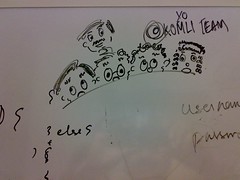
While we hacked code in Java, PHP, AJAX and C 12 hours a day, and listened to rock and the latest Bollywood tunes of Bhool Bhuliyaa, the continued to have a sense of humor. This is a sketch that one of us drew on the whiteboard, while he was designing a new DB schema for user authentication.

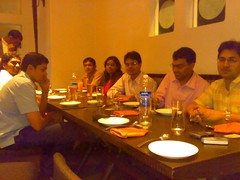
And, did I mention, we never miss a chance to have fun ...


Labels: , , , , , , , ,

Friday, July 27, 2007

Startup: Focus on the problem

Peter Rip at Crosslink has posted a great article about how Teqlo failed and now they are fixing it. I am reproducing a few excerpts, and my comments:
First, let me admit we went down a mashup rat hole. We have a general technology for snapping together web services. "Because they can" is an insufficient answer to "why do people want to create mashups?" We failed to commit to solve a specific problem for a specific market, preferring instead the broad appeal of generality. This has changed.
I have seen so many people having great ideas, looking for problems to solve. So basically, you have a solution, and you are looking for a problem. This almost never works this way, even though it seems (obvious enough) that it should work.
The first thing we did was toss out any pretense of solving everyone’s problem. There is an old proverb that I just invented for this situation -- “The boiling of the ocean begins with a single puddle.” We had to define our puddle. So we did.
Peter has hit the nail on the head. Trying to solve all problems at once is one of the biggest problems you can face. You need to have laser sharp focus on one specific problem area that you want to solve. It is very possible that 80% of your friends will tell you “why don’t you also do this, this is in adjacent space (technologically)”, “if you don’t do this, you will miss out on all the opportunities in that (other space)”. My advice is to tell your friends is “we will get to that”.

Labels: , , ,

Friday, July 13, 2007

Venturing into venture capital? Be ready.

Amar Goel posted a great writeup on venture capital. It is a must read for anybody who wants to raise money for their business:

The 3 lines I liked the most are:

“Raise VC money only … If you would like to build at least a $20M business over 3-5 years and ideally a $100M+ business over 5-7 years you are a prime candidate for venture capital. If you want to build a $3M business over the next 5 years do not raise venture capital.”

“It takes a lot of time to raise venture capital. [At Chipshot.com] Turning that interest into funding took 4 months of almost full-time work. I basically spent 15 hours a day on phone, email and in meetings selling the heck out of my company and our team. ”

“Most VCs will be loathe to invest in some “idea” you have that will change the world that nobody has ever done before.”

I have met many entrepreneur-aspirants who want to raise VC money, but have very little idea of how soon they can get paying customers, and how much those customer are going to pay them and why. I believe it is very very very important to have a clear idea of the business - who is the customer, why will he use your software (or hardware), why would he pay you for the product, how much will he pay you for the product, how would you approach this customer, how often will the customer pay you, how sticky is the product (I mean will they pay once and that's it), etc.

Labels: , , , , ,

Sunday, June 17, 2007

The Age Question

Fantastic post by Fred Wilson:

Brad suggested I write this post. I've been reluctant because I don't want to pick at this scab of a meme. I really don't want to be the guy who made it harder for anyone older than 30 to get funded in the web services market.

The answer lies in Marc Andreessen's words of wisdom about the web:

After an initial phase of the Web as a medium, in which lots of people attempted to make the Web look like a newspaper, or a magazine, or a TV channel, we as an industry have recently been collectively developing a much clearer idea of what the Web is really like as a medium in and of itself.

This has led to broad realization of a set of design patterns for how Web services and Web companies often get built and used.

Who is developing this "clearer idea"? Who is developing the set of "design patterns"? It's the younger generation. And its important to understand why.

It is incredibly hard to think of new paradigms when you've grown up reading the newspaper every morning. When you turn to TV for your entertainment. When you read magazines on the train home from work.

But we have a generation coming of age right now that has never relied on newspapers, TV, and magazines for their information and entertainment. They are the net natives. They grew up in AOL chatrooms, IMing with their friends for hours after dinner, and went to school with a Facebook login.

But the truth is that some of the most interesting things I've seen this month and this year are the creations of kids who barely shave. And it's not an accident.

Labels: , , ,

Thursday, May 31, 2007

Komli Mixer roundup

The Komli Pune Mixer event was attended by close to 50 people from various startup companies in Pune. It was a get together where folks from the founder and CEO/CTO community met engineers and hackers from a number of startups. Check out the attendance demographics.

We had people coming from very different technology and business areas – from Avaya to Zmanda. We had participation from 42 companies in Pune. Some of the notable company representations were from BookEazy.com, EverGrid, MeraTrip.com, Officewalla.com, PANTA Systems, Persistent Systems, Sakaal Papers, SunGard, Symantec, Symphony Services, Xite etc.

Some people are doing really interesting stuff. Like Xite etc who are developing some very cool technology for video restoration, and think that their technology can reduce the costs of video-restoration by up to 90%. MeraTrip.com, that does trip-plan aggregation. Officewalla.com that makes CRM software. Etc.

This is probably for the first time that we had such a get together in Pune, where we had people from Pune startup community meet; I feel we had a very unique combination of CEOs, founders and engineers in this event. See chart to see the attendance demographics.


Most people that I met were young, energetic, “entrepreneur type” people, it was very cool to meet such people. We had good beer and tikka served from Sarjaa. A good number of people that I met thought that this was a very useful event, and we should organize more such events.

Labels: , , ,

Friday, May 25, 2007

Event Alert: Komli Pune Mixer

Komli Pune Mixer

When Wednesday, 30 May, 6:30 – 9:30 pm
Where Komli Media Pvt. Ltd.,
A-4, 2nd Floor,
Nav Vrishali,
(Above Cosmos Bank),
ITI Road, Aundh,
Pune 411007.

Directions


Komli's Mixer is ground-zero for meeting people in the Pune startup community. Based on the philosophy that good ideas become better when discussed with great people, Komli's Mixer is a platform to network with people who are interested in and/or doing startups.

Entrepreneurs, working professionals, hackers and VCs -- all are welcome. Budding entrepreneurs will have an opportunity to talk to some of our distinguished guests.

Snacks and soft drinks will be provided.

Attendees are strongly encouraged to confirm attendance since the venue might not be able to hold more than 40 people.

Please signup at http://komlipunemixer.eventbrite.com. For suggestions and feedback, please email veyron@komli.com .

Labels: , , , , , , , , ,

Thursday, May 10, 2007

Startup joining Dilemma

It’s an interesting dilemma about when you should join a startup company, when you are young or when you are old. Lately, I have talked to people who are young and people who are old (I mean my age). When I talked to old people, they tell me that it is too late to do a startup or get into a startup. They look at me with a stare similar to – “are you out of your mind”. They tell me about the home loan, the kids that go to school and their lavish lifestyle. Some of them tell me about their health problems. Some of them tell me that they are “much higher than startups”, and startups is for people like me. While, deep inside, I know what really keeps them away from getting out of their comfort zones. When I talked to young people, I hear – is this the right time for me, I think I should work for a large company and “gain some experience”. What’s wrong with working in a large organization? Can I really take risk at this point in my career, I am just beginning to work, and won’t it cause problems?

I find this very interesting. I like to lecture people about this dilemma; it almost seems like my favorite topic.

While it is obvious that the best time to take a risk is at the beginning of your career. When you are young and energetic. When you can work 24 hours without a break. When the fire to know more, to solve problems in half the time your nearest competitor can. This is the time when you don’t have house loans, when you can go home late, and come back to office early (or you can sleep at the office). Remember that the next time you will have no-house-loan will be 15 years hence.

I think the young in India should take more risk. Join a startup, make something happen, work hard, build something.

Disclaimer: I co-founded Komli, and currently run the engineering at Pune, India.

Labels: , , ,

Wednesday, December 20, 2006

Record Year for M&A

As of Monday morning, announced global M&A activity topped $3.5 trillion, according to Thomson Financial. That puts the year above the all-time record set in 2000, when about $3.38 trillion in deals were announced.
Big deals have pushed up this year’s performance in dollar value. The total number of deals announced this year has reached 34,785, which means the average deal has carried a value of slightly more than $100 million, according to Thomson data.

Labels: ,

Friday, December 08, 2006

YouTube vs. Fox + NBC + CBS

Michael Arrington reports a very interesting story on Techcrunch:
This is a rumor that just won’t die: The major television networks are considering creating a new online video service joint venture to compete with YouTube.

Here’s what we’ve heard: a few major networks want to create a YouTube competitor, and they have been seriously discussing this for months prior to the YouTube/Google deal. The technology is fairly straightforward, and would be based on Adobe’s Flash platform. The networks would then license their online rights to content to this new service, allowing users to legally watch full episodes of tv shows on the site. Simultaneous to the launch of this new service, the networks would launch massive litigation against Youtube/Google for copyright violations, forcing them to pull the content off of YouTube.

But discussions have stalled. First, Google has offered substantial payoffs to the networks to keep their content on YouTube. Second, complications over how to split revenues from advertising have lengthened discussions. Our understanding is that Viacom and Disney have dropped out of the discussions entirely, but that Fox, NBC and CBS are still trying to put a deal together.

Labels: , , ,